Appearance
Describing Workflows Is Becoming a New Way to Build Software
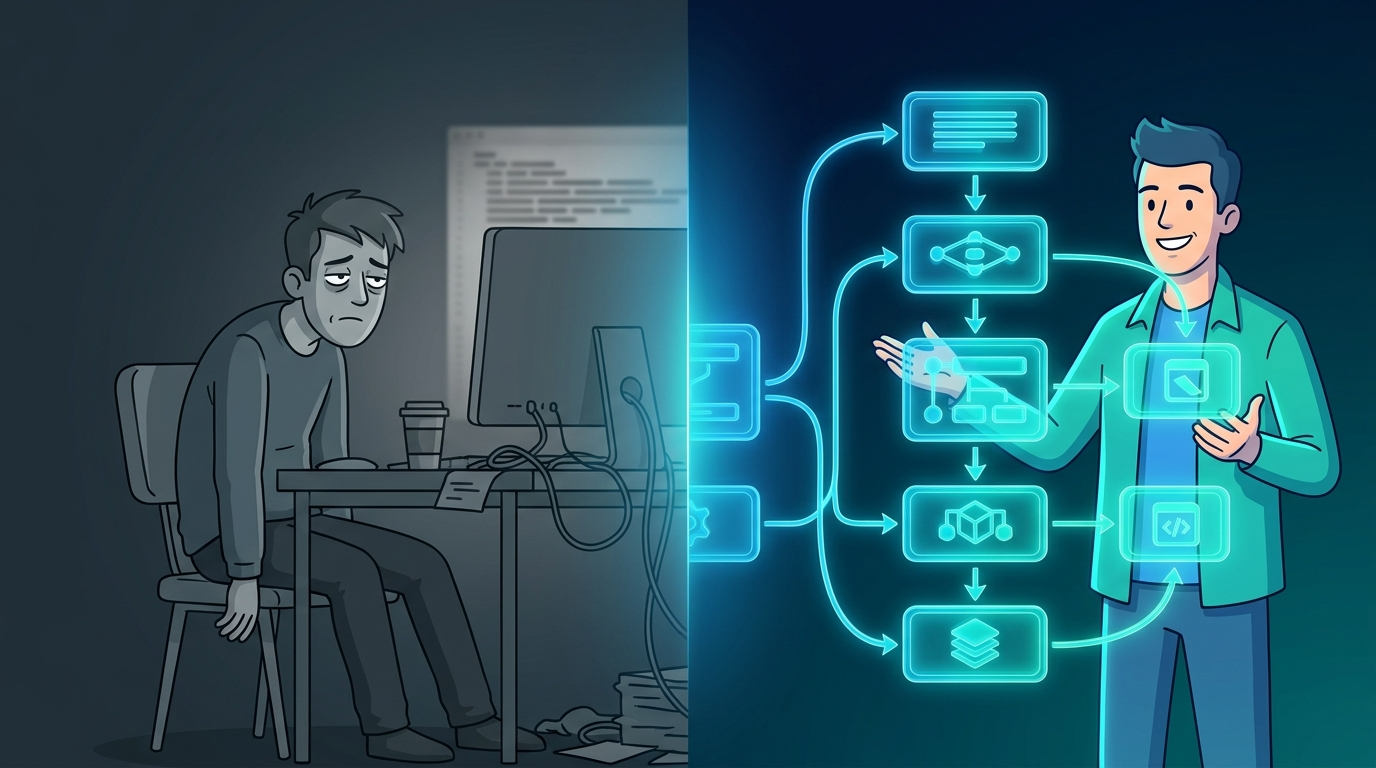
For a long time, building software meant translating an idea into code.
You had to think in variables, functions, databases, syntax, deployments, servers, and all the small technical decisions that sit behind a working application.
If you were not a developer, you usually had two choices:
- Use a generic tool that did not quite match how your business worked.
- Hire someone to build custom software for you.
Both options came with limits.
Generic tools force you to adapt your process to the tool.
Custom software can take time, cost money, and make every future change feel like another development project.
But the way we build is changing.
AI and low-code tools are making it possible for more people to turn a clear description of a process into a working system.
The skill is shifting from writing every line of code to understanding the workflow well enough to describe it.
The new question is not "Can you code?"
The new question is: can you clearly explain how the work should happen?
Think about the tools people already use every day.
A document starts with an idea. You write what you want to say.
A spreadsheet starts with a process. You add columns, rows, formulas, and totals based on what you want to track.
An app can work the same way.
You begin with the real work:
- What information do we need to record?
- Who will enter it?
- Who should be allowed to see it?
- What should happen after someone submits a form?
- What does a manager need to review?
- What should be calculated automatically?
- What happens when someone is working without internet?
Those questions are not technical questions first.
They are process questions.
And the people closest to the process usually know the answers best.
It may be the business owner who understands how orders move through the shop. It may be the operations manager who knows where deliveries get delayed. It may be the school administrator who understands attendance. It may be the person who has been maintaining the same spreadsheet for years.
They may not write code.
But they understand the system that needs to exist.
Software is moving closer to the people doing the work
For many internal tools, the hardest part is not creating a screen.
The hardest part is understanding the process behind the screen.
Take a delivery business.
The business may need to:
- Record incoming orders.
- Assign each order to a driver.
- Show drivers only the deliveries assigned to them.
- Let drivers update delivery status.
- Capture delivery location and customer confirmation.
- Let an operations manager see which deliveries are pending, completed, or delayed.
- Keep working when a driver loses internet connection.
That is a workflow.
In the past, someone would need to explain that workflow to a developer. The developer would translate it into database tables, screens, permissions, application logic, and deployment steps.
Now, a business can increasingly model that workflow directly.
The business owner or operations manager can describe the information they need, create the screens their team needs, define the rules, and refine the tool as the work changes.
That does not mean every app can be built without developers.
Complex public products, large-scale systems, specialised integrations, and high-risk software will still need engineering expertise.
But a stock tracker does not always need a full software team.
A staff-attendance tool does not always need months of planning.
A delivery workflow does not always need a custom app project.
Sometimes a team simply needs a clear process and a practical way to model it.
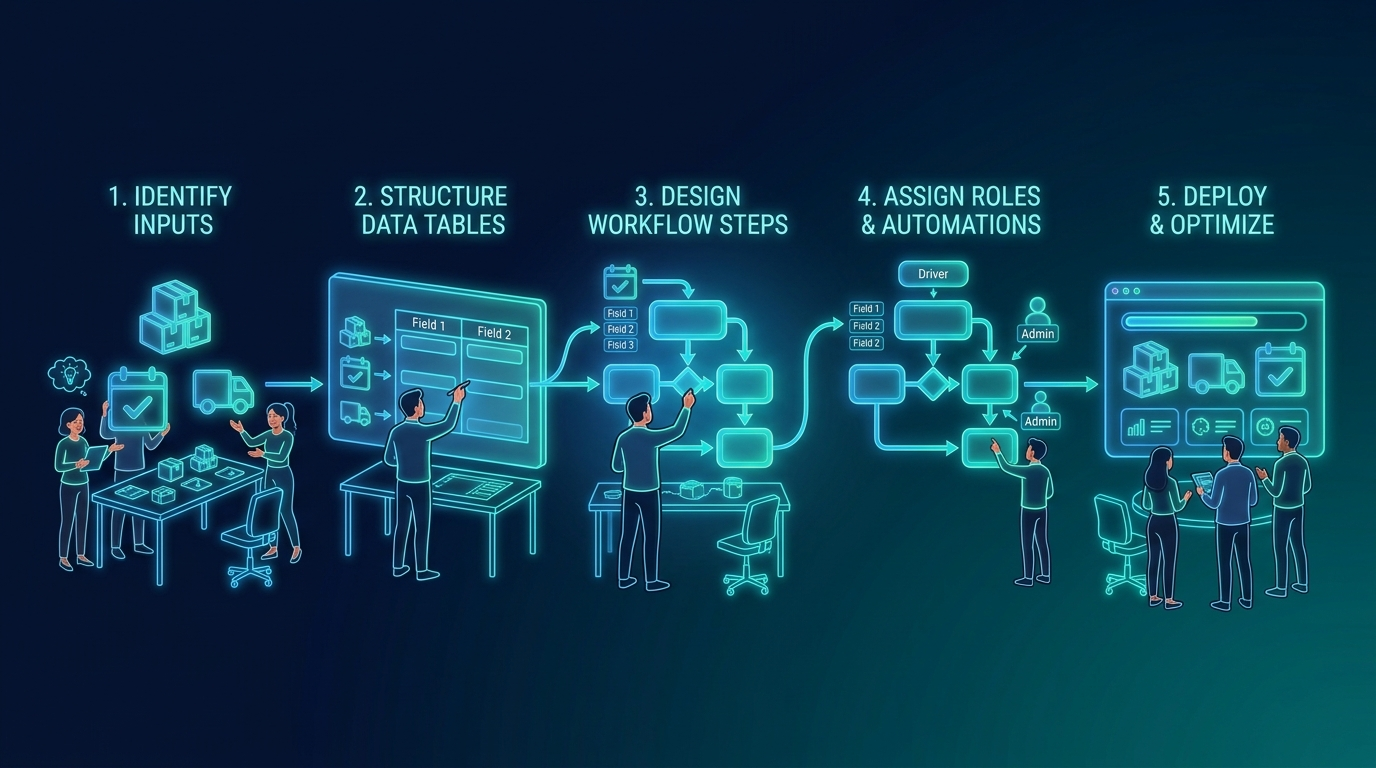
From "write code" to "describe the system"
The important shift is not that technical thinking disappears.
It is that more people can work at a higher level.
Instead of beginning with code, they can begin with the structure of the system.
For example, imagine a small retail business that wants to manage stock and sales.
The business does not need to start by thinking about databases or application architecture.
It can start with plain questions:
- We need products.
- Each product needs a name, price, cost, category, and stock quantity.
- We need to record sales.
- Each sale can contain multiple products.
- Cashiers should be able to create sales.
- Managers should be able to update product details and see revenue reports.
- Stock should reduce when an item is sold.
- The team should still be able to work when the network is unreliable.
That is already the foundation of an app.
The process becomes collections, fields, views, actions, formulas, and access rules.
The business has not needed to write a semicolon, create a server, or map variables by hand to reach that point.
It only needed to understand what it was trying to make easier.
What this looks like in Axiomers
Axiomers is built for this way of working.
It is a low-code builder for internal business tools. You start with the workflow, then shape the app around it.
A builder can:
- Create collections for the things the business tracks, such as products, orders, staff, customers, deliveries, or bookings.
- Add fields for the information that belongs to each record.
- Choose views such as tables, cards, calendars, charts, and dashboards.
- Add actions that update records, create related records, update several records at once, or run multi-step workflows.
- Use spreadsheet-style formulas for calculations and business rules.
- Configure roles and permissions so each person has the right level of access.
- Share the app with the people who need it.
A new collection already begins with a basic table view, detail view, and create, edit, and delete actions. From there, the builder changes the app until it matches the team's real process.
The goal is not to remove thought from building.
The goal is to let people put their thought into the workflow instead of into technical setup.
AI reduces the blank-page problem
AI makes this even easier to start.
Axiomers lets a builder describe an app in plain language and generate a starting schema.
For example, you could write:
Products with name and price, and a stock collection tracking quantity per product.
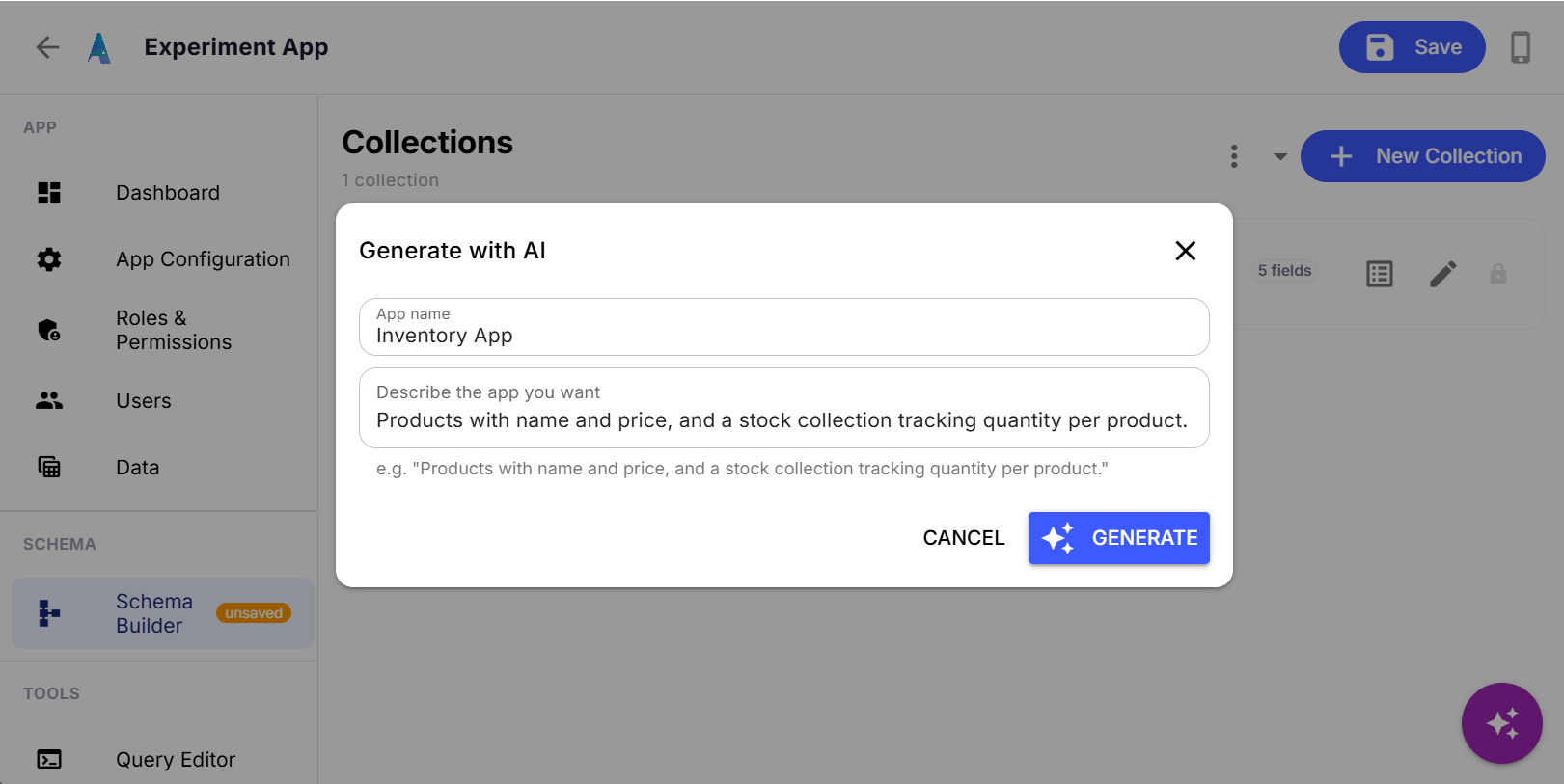
That can become a starting structure for the app: the collections, fields, and views needed to begin.
You can then refine the structure by hand or ask the AI for a change, such as adding a long-description field to products and showing it in the detail view.
The important part is that the AI does not take control of the app. It suggests a structure, shows the changes, and waits for the builder to review and save them.
That is how AI should help in this kind of work.
Not by pretending it understands every business perfectly.
But by helping people move from a clear idea to a usable first version faster.
The app should follow the business
A workflow is never truly finished.
A shop changes its pricing.
A school adds a new class.
A logistics company changes how drivers confirm deliveries.
A manager realises the team needs a new field, a new dashboard, or a better approval step.
With traditional custom software, even a small change can become a request, a quote, a development task, and a wait.
With a low-code builder, the person who understands the process can make the change closer to the moment it becomes necessary.
- Add a field.
- Update a view.
- Change a role.
- Add an action.
- Adjust the workflow.
The app follows the business instead of forcing the business to wait for the app.
It also has to work in the real world
Describing a workflow is only useful if the finished app works where the work happens.
Many businesses do not operate from a desk with stable internet all day.
Their people work in warehouses, shops, classrooms, vehicles, customer locations, event venues, and field sites.
That is why Axiomers is offline-first.
Changes save directly on the device, even without an internet connection. Team members can continue to browse records, create new records, edit existing information, and use workflows while offline. When a connection becomes available, changes sync automatically.
For a driver, that means a weak signal should not stop a delivery update.
For a field officer, it means information can still be recorded during a visit.
For a warehouse worker, it means a stock update does not have to wait for the network.
The workflow should not stop because the connection does.
The future is not "everyone becomes a developer"
Not everyone needs to become a software engineer.
But more people will need to become comfortable thinking in systems.
They will need to identify the steps in a process, the information that matters, the people involved, the decisions that need to happen, and the results they want to see.
That is a valuable skill.
It is the difference between saying:
We need an app.
And saying:
We need to record orders, assign them to staff, give each role the right access, calculate totals automatically, and let the team keep working even when internet is unreliable.
The second sentence is already a build plan.
AI and low-code tools are making it possible to turn that kind of clarity into working software.
Start with one process
You do not need to digitise your entire organisation in one week.
Start with one process that is currently painful.
It could be:
- Inventory and sales.
- Customer orders.
- Staff attendance.
- Delivery tracking.
- Field reporting.
- Booking management.
- School records.
- Internal requests and approvals.
Describe how the work happens today.
Identify what information should be tracked.
Decide who should do what.
Then build the first version.
Axiomers lets you start with one app and up to 50 users on the free plan, with no credit card required. Build a tool around one real process, let your team use it, and improve it based on what happens in the real world.
Start building with Axiomers. No waitlist.